
Business storytelling · Perth, Western Australia
Business storytelling coaching for leaders, boards and sales teams who need people to understand, remember and act. Not applause. Decisions. It’s part of David’s presentation skills coaching.
“Business storytelling isn’t about once upon a time. It’s about making a point people remember.”
Why facts alone aren’t enough
Data is unorganised. Information is data with context and meaning. A business story is how you give it that meaning. Facts answer “is it true?” A story answers “why should I care?” You don’t have to choose. The strongest case is evidence plus meaning.
Version A · The data
Q3 complaints: +18%
Avg resolution time: 6.2 days
Cases over 6 days: 412
Recommendation: add 2 FTE to billing support
Accurate. Complete. And forgotten by morning tea.
Version B · The same data, with meaning
Margaret rang us three times in August about the same billing error. Each time she told her story from the start, to someone new.
On the third call she said, “I’m not angry any more. I’m just tired.”
She was one of 412 customers who waited more than six days last quarter. That’s an 18% rise. Two more people in billing support would fix it. Behind that number is a lot of tired customers.
An illustrative example. Same numbers, same recommendation. Only one gets remembered.
This isn’t the soft stuff
Think of your message as freight. The strategy, the data and the recommendation are the cargo. The story is the truck that gets it to the people who have to act. A brilliant strategy nobody understands is cargo left sitting on the dock.
A story can’t rescue weak thinking.
Shows whether the argument is sound.
What you want them to agree to or do.
Gives all three a human, memorable shape.
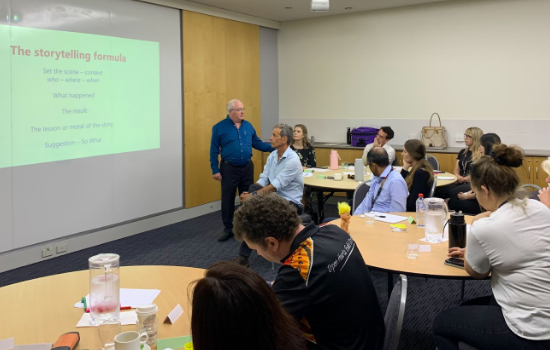
The simplest business story structure
That’s all a business story needs. You don’t need a campfire or a hero’s journey. You need five beats, and the last one matters most.
Where were we?
A project manager has ten minutes with the board to ask for $2m to replace an ageing pump station.
What happened?
Last time she showed 22 slides of failure rates. The board deferred it.
What did we do?
This time she opened with one night. 2am, a pump down, four crew in the rain, a street 40 minutes from flooding.
What changed?
Then the same failure-rate chart. The board approved the spend in that meeting.
Why am I telling you this?
The data didn’t change. The board’s understanding of it did.
An illustrative example. About 30 seconds when spoken.
Try it yourself
Most business stories are far shorter than people expect. Thirty seconds, ninety seconds, three minutes at most. Fill in the five beats with your own story and see how long it runs. Take as long as necessary, but no longer.
Your story, read aloud
The checklist
Put a person at the centre. People relate to people, not departments.
Why does this matter to this audience, right now?
Just enough situation for them to picture it.
The decision, surprise or turning point.
A concrete result, not a vague statement of success.
The lesson. Make the link obvious, then stop talking.
A story isn’t entertainment. It’s evidence with emotion.
Where business stories do their work
Storytelling isn’t a separate party trick. It’s the thread through each of my six pillars. Here’s what it looks like in each one.
Own the Room
Don’t announce “I’d like to tell you a story.” Start inside the action.
Master the Meeting
A two-minute example can cut through an hour of abstract argument.
Win the Pitch
The customer is the hero. Your product is the guide, kept in proportion.
Command the Stage
Layering, callbacks, story loops and sequencing for longer talks.
Lead the Conversation
Don’t tell people your values. Tell them a story. And never use one to disguise bad news.
Read the Room
Executives want the stakes fast. Teams need the people and process. Customers want their own problem.
Mistakes and myths
You already are. Every time you explain what happened at a meeting, you tell a story. The question is whether you tell it well, on purpose.
Your story isn’t about you. It’s about the point it makes for your audience. Small, everyday moments are often the most believable.
A 30-second story can save a 30-minute argument. What wastes time is a message nobody remembers.
Agreed. Keep every fact. A story is the context that tells people why the facts matter.
They belong in board papers, sales calls, team meetings, job interviews and council chambers. That’s where decisions get made.
Strategic storytelling for senior leaders
The higher you climb, the more people expect you to have the answers. So most senior leaders lead with facts, figures and frameworks, then wonder why the message didn’t land. The most powerful communicators in any boardroom are rarely the ones with the best data. They’re the ones with the best stories. At the senior level, moving people is the whole job.
When you need a board to back a difficult decision, a leadership team to commit to a new direction, or a room full of sceptics to believe in a vision they can’t yet see, data alone won’t get you there. A well-chosen story, told with precision and purpose, makes the rational decision feel right.
Every story has to pass one test before it earns its place: So what?
If the answer isn’t immediately clear, the story isn’t ready. At the executive level, a story that doesn’t land doesn’t just get forgotten. It erodes credibility.
Three things have to align
Most senior leaders have more powerful material than they realise: the decisions, failures and turning points that shaped how they lead. In executive storytelling coaching we open the filing cabinet of your career and find the folders that contain gold. Some stories you’ll use constantly. A few will surprise you completely.
At the senior level, a story that feels forced is worse than no story at all. Experienced audiences notice immediately. You’ll learn to build stories into your communication so they feel inevitable, like they were always meant to be there.
Who it’s for: CEOs and managing directors leading through uncertainty, senior executives presenting to boards, investors or government, and leaders driving change who need people to believe in a direction they can’t yet see.
How we can work together
Delivered face to face in Perth and across Western Australia. Happy to travel interstate and overseas for the right engagement. Online coaching is available too.
45 to 60 minutes
For conferences, leadership retreats and company events. Lively, practical and built, of course, around stories.
Half day or full day
For leadership teams, sales teams and managers. Everyone leaves with a story bank and stories they’ve actually told out loud.
One-on-one
For CEOs, board chairs, executives and anyone with a high-stakes moment coming up. A pitch, a keynote, a change announcement.
Your coach
I’m David Julian Price. I’ve been standing up in front of audiences since I walked into Rostrum in 1980, and I’ve been helping other people do it better ever since.
I’ve spent a lot of my career in boardrooms and meeting rooms, as a chair, a facilitator and an Independent Presiding Member on local government audit committees. So I’m less interested in stories that get a laugh and more interested in stories that get a decision.
I work from Perth with clients including Qantas and organisations across Australia, the USA, Dubai and Asia.
Short videos, real problems
Every video starts with a business problem, not a theory. Start with this one.
Questions
It’s giving meaning and context to information. Something happened to someone, something changed, and there’s a point. It helps people understand what the facts look like in a real situation so they can think, decide or act.
Usually much shorter than you think. Thirty seconds to three minutes covers most situations. The story is finished when the audience has what they need to get the point.
When a straight answer will do. When you’re dodging the question. When confidentiality is involved. And when the audience needs precision, like a legal or technical answer.
Yes. Technical work still involves people, choices and consequences. We don’t dumb down the content. We find the moment when something mattered and build around it.
Clients, mistakes, wins, difficult conversations and decisions you had to defend. Start a simple story bank: the event, the point, and where you might use it.
I’m based in Perth and most of my work is here and across Western Australia. I’m happy to travel for the right engagement, and coaching also works well online.
Yes. Strategic storytelling for senior leaders is about influence: getting a board, a leadership team or a room full of sceptics to back a decision or a direction. We mine your own career for the right stories and build them into your communication so they land.
Because nobody ever said, “Explain that spreadsheet again.” I’ll show you how to turn facts, data and complex ideas into stories people remember and repeat. Clients call me the master of the metaphor, which is a story for another day.
Let’s talk
Tell me about the moment coming up. A board paper, a pitch, a keynote, a change you need people to get behind. We’ll find the story that carries it.