
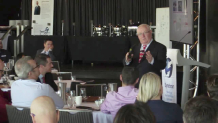



Make This the Year You Become a Confident and Persuasive Speaker
There is a version of you that commands a room. That lands a message with precision. That walks off a stage — or out of a boardroom — knowing you gave the audience something they will carry with them long after they leave.
That version of you is closer than you think. But it requires four deliberate moves. Here they are.
1. Face the Fear — and Ask the Right Question
Ask almost anyone what scares them most and public speaking will be somewhere near the top of the list. It sits comfortably alongside spiders, heights, and the thought of getting up at a wedding and saying something that matters.
Here’s the truth: the fear is natural. Even the most seasoned speakers feel it. The butterflies never fully disappear — the goal is simply to get them flying in formation.
The only way through fear is straight through it. Not around it. Not under it. Through it.
But before you do, ask yourself this one powerful question: “What is the worst thing that could realistically happen to me?”
Write down every answer. Then rate each one on a scale of 1 to 10 — how likely is it to actually happen? Ignore the low-probability answers. For anything that rates high, ask yourself one more question:
“And if that happened — so what? Will I be dead?”
The answer is no. It is always no. The worst thing that can happen when you stand up to speak is almost always — nothing. The catastrophe lives in your imagination, not in the room.
Move the fear out of the way. There is an audience waiting.
2. Get Your Message in a Nutshell — Before You Write a Word
Here is a trap that catches even experienced speakers: they speak at length, with energy and apparent purpose, and at the end the audience is no clearer on what was actually being said than when they started.
The problem is not the delivery. The problem is that the speaker never truly knew their own message.
Think of your message as a magnifying glass held over paper on a sunny day. When the glass is held still and focused, it lights a fire. When it moves — even slightly — nothing ignites. No focus, no fire.
Before you prepare a single slide, write a single note, or rehearse a single sentence, you must be able to complete this sentence in one crisp, clear phrase:
“What I want my audience to leave knowing, feeling or doing is…”
If you cannot complete that sentence with one clear answer, you are not ready to prepare yet. Go back and think until you can. Everything else flows from that one focused point.
3. Spend More Time on HOW Than WHAT
Most speakers — especially those still finding their feet — make the same mistake. They pour the majority of their preparation time into their content. Into what they are going to say.
This is the single most common trap in public speaking. And it will cost you every time.
Here is the counterintuitive truth: it is not your content that determines your success. It is your presentation of that content. How you deliver it. How you bring it to life. This applies without exception — even for technical presentations to highly specialised audiences.
Your content is the skeleton. Your presentation is the body that moves, breathes, and connects.
Practically, this means:
Plan your content using bullet points — never full sentences. The moment you write out your presentation word for word, you have written a paper, not a speech. It will sound like one too.
Use your bullet points as memory anchors, not scripts. Then ask yourself — for every single point — “What is the best way to bring this to life for this audience?”
The answer will almost always involve one or more of these: a story, an example, an analogy, a metaphor, a statistic that surprises, or an anecdote that makes people laugh or lean forward. These are the tools of the master communicator. Use them liberally.
The content gets you in the room. The presentation is what gets you invited back.
4. Perform — Every Single Time
Every presentation is a performance. Every one.
It does not matter if the audience is two people or two thousand. It does not matter if the venue is a boardroom, a conference hall, or a community meeting room with flickering fluorescent lights. Your audience showed up. They gave you their time — the one thing they can never get back.
That deserves your absolute best.
Think of every presentation as your Oscar-winning performance. Walk in prepared, committed, and fully present. Give that audience everything you have. Not 80%. Not “I’ll save my energy for the bigger crowd next week.” Everything. Now.
The reward is significant — and it works on multiple levels. An audience that sees a performer who genuinely cares about them will respect your mastery, trust your message, and — yes — be far more likely to act on what you are asking them to do. Whether that is buying a product, changing a behaviour, or simply believing in an idea.
Because here is the truth that every great speaker eventually discovers: every presentation is a sale. You are always selling something — an idea, a vision, a call to action, a version of the future. And people buy from people who show up with full commitment.
Your Move
You now have four strategies that can genuinely transform the way you communicate this year. Face the fear with a better question. Lock in your message before you prepare. Invest your preparation time in how, not just what. And perform — every time, for every audience.
The stage is set. The audience is waiting.
This is your year.
David Julian Price is an inductee into the Australian Speakers Hall of Fame, a Certified Speaking Professional, and one of fewer than 40 Global Speaking Fellows worldwide. He coaches individuals and organisations across Australia and internationally in the art of powerful, purposeful communication. Visit davidprice.com to learn more.